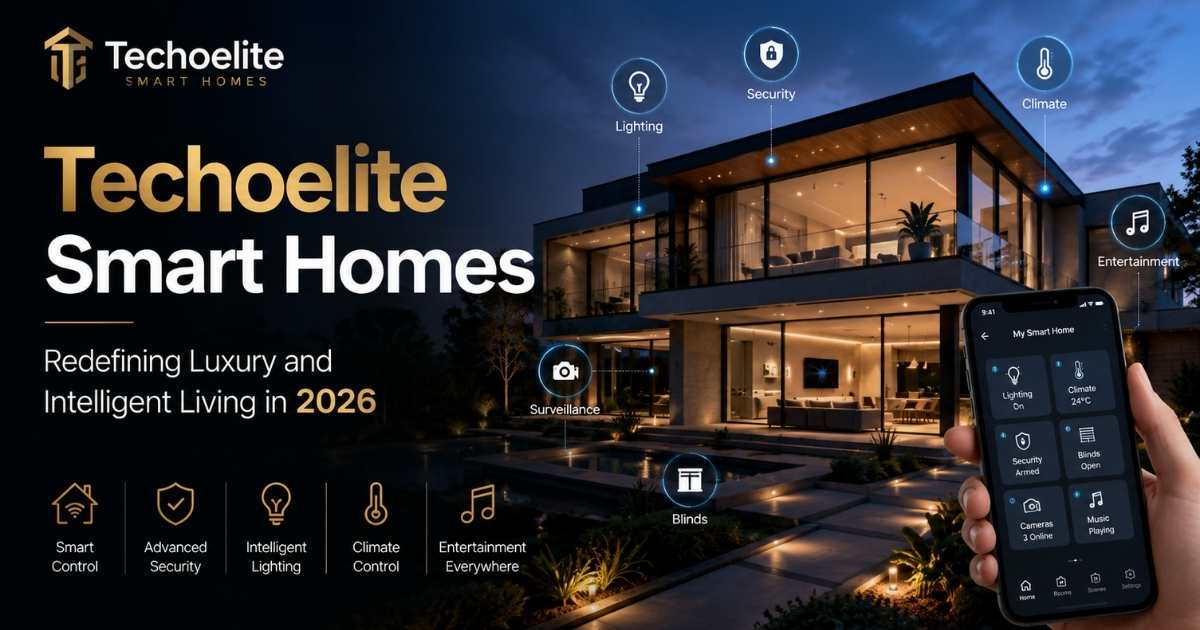

Techoelite Smart Homes are changing the way people experience daily life at home. Instead of manually controlling lights, locks, and temperature, everything now responds automatically. Your home adjusts to your routine without you lifting a finger. That is exactly what smart living looks like in 2026. More American homeowners are choosing intelligent automation every single day. They want comfort, security, and energy savings all in one place.
Techoelite Smart Homes deliver all of this through one connected ecosystem. Artificial intelligence learns your habits and makes your home smarter over time. Whether you are building a new house or upgrading an older one, smart technology fits any property. This guide covers everything you need features, benefits, devices, costs, and the future of intelligent living. Your smarter home starts here.
What Are Techoelite Smart Homes?
Techoelite smart homes are fully integrated residential systems where lighting, security, climate control, energy management, and entertainment work together through automation and AI. Instead of controlling each device manually, homeowners manage everything from a single app, voice assistant, or centralized hub.
These systems connect devices via Wi-Fi, Bluetooth, Zigbee, or the Matter protocol a universal standard gaining popularity in 2026 for its cross-brand compatibility. Once connected, devices communicate with each other intelligently, creating an environment that responds to occupancy, habits, and preferences automatically.
Think of it this way: your home learns when you wake up, adjusts the thermostat, starts the coffee maker, and disarms the security system all before you reach the kitchen.
Related POST: Why Organic Modern Kitchen Designs Taking Over in 2026
Why Smart Home Technology Is Growing Rapidly
Several powerful forces are driving demand for smart home automation in 2026:
- Rising energy costs push homeowners toward systems that optimize consumption automatically
- Remote work has increased how much time people spend at home, making comfort and efficiency more important
- Security concerns are fueling adoption of AI-powered surveillance and smart locks
- Property value increases when homes include automation features a key motivator for sellers and buyers alike
The US retrofit segment adding smart devices to existing homes held 51.18% of the smart home market share in 2026, proving that smart living is not just for new builds.
| Growth Driver | Impact on Smart Home Adoption |
| Rising energy bills | Higher demand for smart thermostats and energy monitors |
| Remote work culture | Greater need for comfort automation and home office control |
| Property value uplift | Buyers actively prefer technology-enabled homes |
| AI advancement | More predictive, personalized automation becoming affordable |
| Matter protocol launch | Simplified device compatibility across all major brands |
The market is projected to grow from $164 billion in 2026 to $311 billion by 2031 doubling in just five years.
Key Features of Techoelite Smart Homes
Intelligent Home Automation
Automation is the foundation of every effective smart home. Automated routines handle repetitive tasks without manual input. A well-designed system might lock all doors at bedtime, lower the thermostat, turn off every unnecessary light, and activate the security system triggered by a single “Goodnight” voice command.
The most advanced setups use AI learning to go further. The system studies your patterns over time and begins auto-applying optimizations without prompts. This shifts smart homes from reactive tools to genuinely predictive environments.
Advanced Security Systems
Security remains the number-one reason homeowners switch to smart technology. Modern techoelite smart homes typically include:
- Smart locks with keyless entry and remote access
- AI-powered cameras with motion detection and real-time alerts
- Video doorbells with two-way audio
- Motion sensors that trigger lights and notifications simultaneously
- Window and door contact sensors for perimeter monitoring
- Integration with emergency services for automatic response
Homeowners receive instant smartphone alerts and can monitor live feeds from anywhere in the world. For families with children or elderly members, this layer of intelligent protection offers significant peace of mind.
Smart Lighting and Ambiance Control
Smart lighting does more than save energy it shapes the entire feel of a living space. With techoelite systems, homeowners can create custom scenes for different moments throughout the day:
- Wake-Up Mode gradual brightness increase to replace jarring alarms
- Work Mode cool, focused lighting optimized for productivity
- Movie Mode dimmed ambiance with automated blinds
- Sleep Mode warm, low light that gradually fades off
Lights respond to occupancy sensors, time schedules, and voice commands. Color temperature adjustments are proven to support natural circadian rhythms, improving sleep quality over time.
Energy Efficiency and Sustainability
Energy management is one of the strongest financial arguments for smart home investment. Key systems include:
- Smart thermostats that learn your schedule and adjust heating or cooling automatically
- Energy monitors that display real-time consumption per device or room
- Smart plugs that eliminate standby power waste
- Automated blinds that regulate natural light and reduce HVAC load
- Solar panel integration for homes pursuing full energy independence
Most users recoup their initial investment within 18 to 36 months through energy savings alone, with some qualifying for insurance discounts of up to 20% with approved security systems.
How Techoelite Smart Homes Work
Understanding the technical flow helps homeowners make better purchasing decisions. Here is how a connected system operates:
- Sensors collect data motion, temperature, light levels, door status, occupancy
- Devices send information to a central hub or cloud platform in real time
- Automation rules trigger responses lights turn on, thermostats adjust, cameras start recording
- AI layer refines behavior the system learns from patterns and suggests or applies optimizations
- Homeowners manage everything via app, voice assistant, or physical control panel
Critical functions like security alerts are handled locally for speed and privacy. Advanced analytics run in the secure cloud. This dual-processing approach ensures the system stays fast and responsive even during internet disruptions.
Best Devices for Building Smart Homes
Choosing the right devices determines how well your system performs long-term. Compatibility is the top priority.
| Device Category | Top Examples | Key Function |
| Smart hub | Amazon Echo, Google Nest Hub | Central control and automation |
| Smart thermostat | Ecobee, Nest Learning | Automatic climate management |
| Video doorbell | Ring, Google Nest Doorbell | Visitor monitoring and two-way audio |
| Smart lock | Schlage Encode, Yale Assure | Keyless entry and remote access |
| Smart lighting | Philips Hue, LIFX | Scene control and energy savings |
| Security camera | Arlo Pro, Wyze Cam | AI-powered indoor/outdoor monitoring |
| Smart plug | Kasa EP25, TP-Link | Appliance control and energy monitoring |
Pro tip: In 2026, Matter-compatible devices are the professional standard. They eliminate ecosystem lock-in and future-proof your investment as new platforms emerge.
Pros of Smart Home Technology
- Convenience automates repetitive daily tasks and reduces manual effort across the home
- Security real-time alerts, AI surveillance, and remote monitoring provide round-the-clock protection
- Energy savings smart management of lighting, heating, and appliances reduces utility costs significantly
- Remote control full home management from a smartphone, anywhere in the world
- Personalization automation routines adapt to individual lifestyles and daily rhythms
- Property value modern buyers prioritize smart-equipped homes, increasing resale appeal
Cons of Smart Home Technology
- Initial cost quality devices, professional installation, and advanced automation require upfront investment
- Internet dependency system performance relies on stable, high-speed connectivity
- Compatibility issues devices from different brands may not integrate smoothly without a shared protocol
- Cybersecurity risks unsecured networks and weak passwords create vulnerabilities
- Learning curve beginners may need time to understand automation platforms and app ecosystems
Best Practices for Individual Users
Starting simple is the smartest approach. Most homeowners make the mistake of purchasing too many devices at once, creating compatibility headaches before they understand how the ecosystem works.
A better starting sequence:
- Upgrade to a smart thermostat for immediate energy savings
- Add a video doorbell for visible security improvement
- Install smart lighting in high-traffic rooms
- Expand to smart locks, plugs, and sensors over time
Strong Wi-Fi coverage is non-negotiable. Weak signals cause device dropouts and unreliable automation. A mesh network system like Eero or Google Nest WiFi is worth the investment before adding more than a handful of devices.
Enable two-factor authentication on all smart home apps and update device firmware regularly. Most cybersecurity vulnerabilities in smart homes come from outdated software, not hardware flaws.
Best Practices for Technical Teams
For professionals managing larger deployments, the approach shifts from simplicity to architecture.
- Network segmentation is critical isolate smart devices on a separate VLAN from guest or work traffic
- Matter-compatible infrastructure is the 2026 professional standard it removes long-term compatibility risk
- Standardized ecosystems across a deployment reduce maintenance overhead significantly
- Scalability planning from day one prevents costly retrofits as client needs grow
- Documentation of device firmware versions, hub configurations, and automation rules ensures smooth handover
Security audits should be scheduled quarterly on professional installations. Device access logs should be reviewed periodically for unusual activity patterns.
Common Mistakes Homeowners Should Avoid
Real-world smart home frustrations almost always trace back to a few predictable errors:
- Buying incompatible devices from multiple ecosystems without checking integration support first
- Skipping network assessment inadequate Wi-Fi undermines every connected device in the home
- Over-automating too fast too many routines running simultaneously can make a home feel unnatural and unpredictable
- Ignoring firmware updates outdated software is the primary entry point for cybersecurity attacks
- Choosing price over compatibility cheap devices without Matter or major ecosystem support often become dead ends
A home should feel intuitive, not like a tech demonstration. Build automation gradually, test each routine thoroughly, and adjust based on real daily use before expanding further.
The Future of Techoelite Smart Homes
The next evolution of smart home technology moves from responsive to genuinely predictive. Instead of reacting to commands, future systems will anticipate needs based on behavior patterns, environmental data, and even biometric signals.
Key developments already emerging in 2026:
- AI-powered climate systems that factor in weather forecasts, occupancy patterns, and off-peak electricity pricing
- Health-monitoring integration sensors tracking indoor air quality, humidity, CO2 levels, and sleep conditions
- Solar panel and EV charging coordination homes managing their own energy generation and storage autonomously
- Smart city integration residential systems connecting to broader urban infrastructure for traffic, emergency, and utility data
- Predictive maintenance alerts appliances flagging issues before they fail
By 2034, the global smart home market is projected to reach $848 billion. The direction is unmistakable: intelligent homes are transitioning from a premium choice to the default residential standard.
FAQs
Are techoelite smart homes suitable for older houses?
Yes. Most smart devices are wireless and install without major structural changes, making retrofits practical for virtually any existing home.
Do smart homes reduce electricity bills?
Significantly. Smart thermostats, automated lighting, and energy monitors together can reduce household energy consumption by 15–30% depending on usage patterns.
Are smart home systems difficult to maintain?
Most modern platforms are user-friendly, but regular firmware updates and periodic network checks are essential for performance and security.
Which smart home device is best for beginners?
A smart thermostat or video doorbell both deliver immediate, visible benefits and are straightforward to install and configure.
Are smart homes secure from hackers?
They can be very secure when users apply strong unique passwords, enable two-factor authentication, and keep all device firmware current.
Conclusion
Techoelite smart homes represent the clearest path from ordinary housing to intelligent, future-ready living. By combining AI-powered automation, real-time security, energy efficiency, and personalized comfort into one connected ecosystem, they deliver measurable improvements to daily life not just convenience for its own sake. The technology has matured enough in 2026 that the benefits are reliable, the devices are affordable, and the learning curve is manageable for most homeowners.
The key to success lies in starting strategically, choosing compatible devices, and building automation gradually rather than all at once. For US homeowners looking to reduce energy costs, strengthen security, and increase long-term property value, investing in smart home technology is no longer a question of if it is a question of when. Those who act now gain both the lifestyle advantages and the financial returns that come with being ahead of a trend that is rapidly becoming the new residential standard.

